

Reading Time: 11 mins

You’ve been studying on your own schedule, managing other responsibilities, and now the NIOS On Demand Exam is approaching. But here’s the problem — most preparation guides online are either too vague or written for regular board students.
The NIOS On Demand Exam (ODE) is different. You set the date. You choose the subjects. And that means the responsibility of preparation falls entirely on you.
This guide gives you a clear, practical plan — not generic tips. Whether you’re a working adult, an overseas student, or someone who failed a subject and wants to clear it fast, this is the guide you need.
Quick Facts
- NIOS ODE allows you to appear for exams throughout the year — not just in April/October
- You can give one subject at a time or multiple subjects together
- The ODE is available for both Secondary (Class 10) and Senior Secondary (Class 12) students
- TMA (Tutor Marked Assignment) submission is mandatory before registering for ODE
- Results are usually declared within 45–60 days after the exam
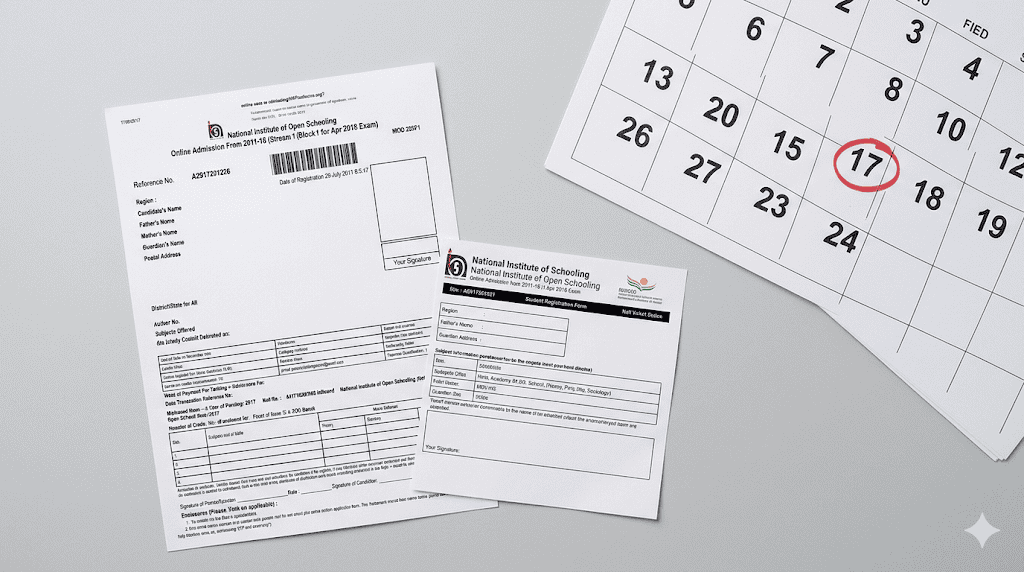
The NIOS On Demand Examination is a year-round examination system offered by the National Institute of Open Schooling (NIOS). Unlike the regular public exam held twice a year, the ODE lets you choose your own exam date within available slots at your nearest exam centre.
In simple terms — you’re not tied to a fixed exam schedule. That flexibility is one of the biggest benefits of open schooling and a primary reason thousands of students choose NIOS over a regular board.
Here’s what makes the ODE different:
To understand all the examination options in NIOS available to you, it’s worth comparing ODE with the public exam before deciding which path fits your situation.
Not every NIOS student needs to take the ODE. But for certain situations, it’s the smartest option.
The NIOS ODE is ideal if you:
If you’re unsure whether ODE is the right path, understanding NIOS on demand exam vs public exam can help you decide based on your goals and current status.
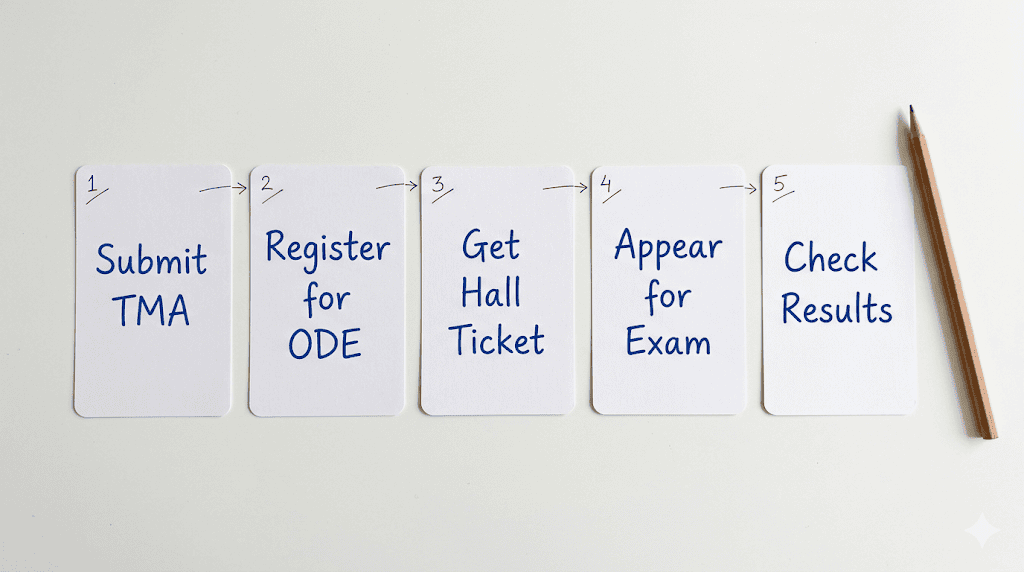
Before you start preparing, understand the process clearly. Many students waste time studying without completing the basic requirements first.
Step 1: Complete Your TMA Submission Before you can register for the ODE, your Tutor Marked Assignment (TMA) for the relevant subject must be submitted and accepted. Don’t skip this — it’s a hard prerequisite.
Step 2: Register for the ODE Online Log in to the NIOS student portal and complete your NIOS On Demand Exam registration. Choose your preferred exam date and subject centre. Pay the required exam fee during registration.
Step 3: Download Your Hall Ticket Once registration is confirmed, download your admit card from the portal. Carry a printed copy on exam day along with a valid photo ID.
Step 4: Appear at the Exam Centre On your chosen date, report to the designated NIOS exam centre. ODE is a pen-and-paper exam — same format as the public exam.
Step 5: Wait for Results Results are typically published on the NIOS portal within 45–60 days of the exam. You can check your NIOS admission and results status online through your registered account.
Most students who fail the ODE don’t fail because the exam is hard. They fail because they had no structure. Here’s how to build one that actually works.
Because you choose the date, many students keep pushing it forward — “I’ll book it next month.” Don’t do that. Set a date first, then work backwards to build your study plan. This creates a hard deadline and forces real preparation.
A safe preparation window is 6 to 10 weeks for most subjects. If you’re clearing a failed subject and already know the material partially, 4 weeks can be enough.
Get the NIOS study material for your subject from the official portal or your study centre. List all chapters. Then divide them into three groups:
This is especially important if you’re following a self-paced NIOS learning approach without a teacher guiding your daily schedule.
| Week | Focus |
|---|---|
| Week 1–2 | Cover all high-weight chapters, take rough notes |
| Week 3–4 | Revise notes, solve sample questions chapter-wise |
| Week 5–6 | Solve past question papers, time yourself |
| Week 7 | Full revision, focus on weak areas only |
| Week 8 (last week) | Light revision, exam logistics, rest |
Keep study blocks to 90 minutes maximum with a 15-minute break. Long unbroken sessions lead to fatigue, not retention.

NIOS exams are not designed to trick you. The pattern is straightforward — if you’ve covered the material and practised writing answers, you’ll do well. Here’s how to approach the most common subjects:
Your TMA (Tutor Marked Assignment) is not optional — it is a mandatory requirement before you can sit for the ODE. But more than a requirement, it’s also a learning tool if used properly.
Here’s how to approach your TMA smartly:
Want to know how TMA marks contribute to your final result? Read more about how NIOS assignment marks are calculated to understand the full marks breakdown.
You don’t need expensive coaching or a pile of reference books. These resources are enough:
1. NIOS Official Study Material Available for free on the NIOS website. These are the textbooks your exam is based on. Every chapter, every exercise — start here.
2. NIOS Previous Year Question Papers This is your most powerful tool. Use them to understand question patterns, time your answers, and identify recurring topics.
3. NIOS Sample Papers Available on the NIOS portal for each subject. Solve them under timed conditions.
4. NIOS Knowledge Base The NIOS knowledge base covers a wide range of exam-related questions — from marking schemes to subject-specific FAQs.
5. Coaching Support (Optional) If self-study feels overwhelming, joining a structured NIOS coaching programme — online or offline — can give you guided support and accountability.
Mistake 1: Booking the exam date without submitting TMA Why it’s bad: You cannot register for ODE without an accepted TMA. You’ll waste time and miss your desired date. Fix: Submit TMA at least 3–4 weeks before you plan to register for the exam.
Mistake 2: Studying everything equally Why it’s bad: You’ll run out of time before covering high-value topics properly. Fix: Use previous papers to identify which chapters appear most. Prioritise those first.
Mistake 3: Only reading, never writing Why it’s bad: NIOS is a written exam. Reading without practice means you’ll struggle to express answers in the allotted time. Fix: Write answers by hand daily — even 2–3 answers per sitting builds speed and clarity.
Mistake 4: Ignoring the NIOS grading system Why it’s bad: Some students don’t know how marks are distributed between TMA and theory. They may neglect one component. Fix: Understand the marks split for your subject before you plan your preparation.
Mistake 5: Picking too many subjects at once Why it’s bad: Spreading focus across 4–5 subjects simultaneously reduces the quality of preparation for each. Fix: If this is your first attempt via ODE, start with 1–2 subjects. Clear them well, then move to the next.
The week before the exam is not the time to learn new topics. It’s the time to reinforce what you already know.
Day 1–2: Revise your handwritten notes. Go chapter by chapter — don’t re-read full textbooks.
Day 3–4: Solve one full past paper each day under timed conditions (3 hours). Don’t check answers while solving.
Day 5: Review your mistakes from Day 3–4 papers. Focus only on areas where you lost marks.
Day 6: Light revision — flashcards, formula sheets, key definitions only. No heavy studying.
Day 7 (Day before exam): Confirm your exam centre location. Pack your bag — hall ticket, ID proof, pens, pencil, ruler. Sleep at least 7–8 hours. Eat well.
On exam day, attempt all questions. If you don’t know an answer fully, write what you do know — partial marks count. Manage your time: don’t spend more than 8–10 minutes on any single long-answer question.
If you want subject-specific time management tactics, this guide on managing time during NIOS board exams walks through it in detail.
The public exam is held twice a year (April and October) with fixed dates. The On Demand Exam lets you choose your own date throughout the year. The ODE is ideal for students who want flexibility or need to clear individual subjects quickly. Learn more about the NIOS on demand exam vs public exam differences in detail.
Yes. You cannot register for the NIOS On Demand Exam without submitting and getting your TMA accepted. Make sure you submit your TMA at least 3–4 weeks before your planned exam registration date to allow for processing time.
Yes. One of the biggest advantages of the ODE is that you can appear for a single subject in NIOS at a time. This is especially useful if you’ve cleared most subjects in the public exam but failed or missed one.
It depends on your current level of familiarity with the subject. Generally, 6–8 weeks of structured study is enough for most students. If you’re starting from scratch, 2–3 months gives you a comfortable buffer. Check the average time required to complete a NIOS course for a broader view.
Start with the official NIOS study material — it’s free and syllabus-aligned. Supplement with NIOS previous year question papers and sample papers from the NIOS portal. Avoid unrelated reference books, as they may cover topics beyond the NIOS syllabus and waste your time.
NIOS typically declares ODE results within 45–60 days of the examination date. You can check results on the official NIOS student portal using your enrollment number.
Yes. NIOS has authorised exam centres in several countries, including the UAE. If you’re an overseas NIOS student, check with your nearest NIOS study centre for ODE availability in your location.
Yes. NIOS is a government-recognised board under the Ministry of Education. ODE results carry the same weightage as the public exam. NIOS certificates are accepted by state universities and colleges across India and are valid for JEE, NEET, and other national-level entrance exams.
If you don’t pass, you can re-register for the ODE and attempt the same subject again. You can also apply for the Transfer of Credit (TOC) in NIOS if you’ve passed that subject in another board previously, which may allow you to carry those marks forward.
Not necessarily. Many students clear the ODE with self-study using NIOS material and past papers. However, if you find a subject difficult or need structured support, enrolling with a NIOS coaching centre — online or offline can make a real difference to your confidence and results.
The NIOS On Demand Exam gives you something the regular board doesn’t — control. You choose when you’re ready. But that freedom only works in your favour if you prepare with discipline.
Here’s what matters most:
The ODE is genuinely designed to help students succeed on their own terms. Thousands of students use it every year to complete their Class 10 or Class 12 without the pressure of a fixed exam window.
If you’re based in the UAE or abroad and need guidance on how to enrol in NIOS or find the right study support, NIOS World can help you navigate the entire process — from registration to result.
Contact NIOS World today and get personalised guidance for your exam preparation, subject selection, and ODE registration — all in one place.
Looking to explore more? Read our guides on how to prepare for NIOS 10th exam, how to prepare for NIOS 12th exam, and how to score 90+ in NIOS board exams.