



You have a job. You have bills. You also have a 10th or 12th certificate gap that keeps blocking your next step — a promotion, a visa upgrade, a college application, or a better job opportunity.
That is exactly why thousands of working adults across India and the UAE choose NIOS every year.
NIOS — the National Institute of Open Schooling — is India’s largest open schooling board recognised by the Government of India. It lets you study at your own pace, appear for exams when you are ready, and complete your secondary or senior secondary qualification without sitting in a classroom every day.
The NIOS flexible learning model is built for people exactly like you — people who cannot take a career break but cannot afford to leave their education incomplete either.
But here is the honest truth: flexible does not mean easy. Without the right structure, most working students fall behind. This guide is going to help you avoid that.
Most working adults do not lack motivation. They lack a plan.
You wake up, go to work, come back tired, scroll through your phone, sleep — and the textbook stays untouched. A week passes. Then a month. Before long, the exam date is three weeks away and panic sets in.
Sound familiar?
The problem is not your dedication. The problem is that you are trying to study the same way a full-time student would — and that does not work when you have eight or nine hours already spoken for every day.
What you actually need is a different approach to learning — one that fits inside your existing schedule, not one that competes with it.
Here is how to build that approach from scratch.
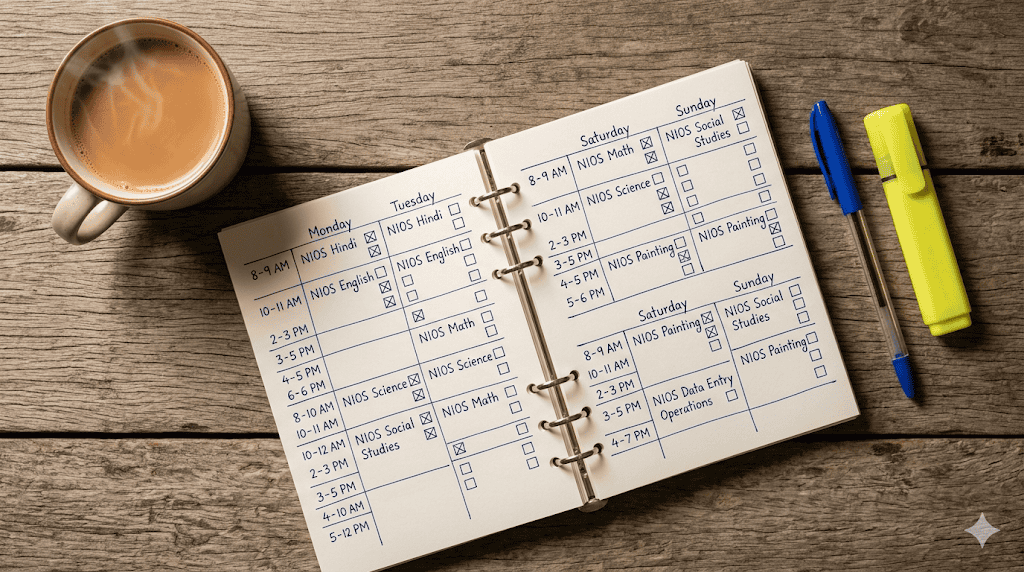
Before you create a study schedule, sit down and map your real day — not your ideal day.
Write down when you wake up, when you leave for work, when you come back, when you eat, and when you sleep. Look at what gaps remain. Even 45 minutes in the morning and 30 minutes at night adds up to more than eight hours a week.
That is enough. You do not need three-hour study blocks to pass NIOS. You need consistency.
Once you find your study windows, protect them like work meetings. Mark them in your calendar. Tell your family. Set an alarm.
A practical schedule for a working professional might look like this:
| Time Slot | Activity |
|---|---|
| 6:00 AM – 6:45 AM | Read one topic or chapter section |
| Lunch break (30 min) | Review flashcards or previous notes |
| 9:00 PM – 9:30 PM | Practice questions or revision |
| Weekend (2–3 hours) | Cover new topics, solve past papers |
The goal is not to study more. The goal is to study without interruption during whatever time you have.
Daily targets feel crushing on bad days. Weekly targets give you flexibility.
Instead of “I will study chapter 4 today,” tell yourself “I will finish unit 2 by Sunday.” If Wednesday goes badly, you still have Thursday, Friday, and the weekend to catch up. That flexibility is the difference between staying consistent and quitting.
This is one part most working students get wrong — they pick subjects based on what sounds familiar, not what suits their available time.
NIOS allows you to choose your subjects, and that freedom is a major advantage. Use it strategically.
If you are good with numbers, subjects like Economics or Accountancy will take less effort than History or Political Science. If you are a strong reader, language-heavy subjects will be manageable with less dedicated study time.
The NIOS subject selection guide on our site breaks down subject difficulty levels and which combinations work best depending on your background.
You can sit for up to five subjects in one exam session. For working adults, three to four subjects per attempt is a more sustainable target. This is especially true if you are taking the exam for the first time or have not studied formally in a few years.
You can always complete remaining subjects in the next session. NIOS’s on-demand exam system also allows you to appear subject by subject, so you are not locked into a fixed exam window.
Explore the different streams available in NIOS before finalising your subject combination.

You do not have eight hours a day to study. That means every hour needs to count more.
Instead of trying to cover an entire chapter in one sitting, break it into three or four small chunks. Cover one chunk per session. This reduces mental fatigue and actually improves retention because your brain processes information during the breaks between sessions.
NIOS provides its own study material with every registration. It is written for self-learners — which means it is more concise and exam-focused than standard textbooks. Stick to this material first before looking for external resources.
Re-reading notes is the least effective study method for time-poor learners. Instead, close your notes after reading a section and try to write down what you remember. This active recall technique forces your brain to retrieve information rather than just passively absorb it — and retrieval is what happens in exams.
Knowing the content is half the job. Knowing how NIOS asks questions is the other half. Make it a habit to solve at least one past paper question set per week, regardless of what chapter you are on.
Visit the NIOS 10th previous question papers section to access past papers for practice.

The exam period is where most working students lose their calm — and their marks.
Six weeks before your NIOS exam, stop learning new content. Switch entirely to revision and practice. Go through your notes, solve past papers, identify weak areas, and target those specifically.
This 6-week window is also the best time to look into the NIOS online vs offline coaching options if you need structured support in your final stretch.
Most employers allow a few days of casual or earned leave. Use them around your exam dates — not just on exam day, but for focused revision in the two or three days before. Plan this months in advance so it does not clash with critical work deadlines.
Knowing how marks are distributed helps you prioritise. NIOS assigns marks for both the written exam and Tutor Marked Assignments (TMAs). If you submit strong TMAs, you already have a scoring cushion before the written paper even begins.
Read the complete breakdown in the NIOS grading system guide to understand how your total score is calculated.
Why it’s a problem: You miss one day and feel like a failure. Guilt leads to procrastination.
Fix: Use weekly targets instead of daily ones. Give yourself built-in catch-up days.
Why it’s a problem: TMAs carry internal marks that count toward your final score. Missing them cuts your total before you even enter the exam hall.
Fix: Schedule TMA submission dates the same way you schedule work deadlines.
Why it’s a problem: You study randomly, cover some chapters twice, and miss others entirely.
Fix: Map all your subjects to a 12 to 16-week study calendar from day one.
Why it’s a problem: The perfect time never comes. Work gets busy. Family needs you. Something always happens.
Fix: Study in imperfect conditions. Fifteen focused minutes is better than zero perfect ones.
Why it’s a problem: You might study the right content but answer in the wrong format.
Fix: Read through the how to clear NIOS exams in first attempt guide to understand question formats and marking patterns before your exam.
A: Yes, absolutely. NIOS is fully open to Indian nationals living abroad, including those working in Dubai and across the UAE. You can enroll through an authorised study centre, attend classes online or in-person, and appear for exams at a designated NIOS exam centre in the UAE. Many working professionals in Dubai have completed their 10th and 12th through NIOS without taking any break from their jobs. Visit the NIOS admission in Dubai page to get started.
A: One to two hours per day is sufficient if you are consistent. The key is not the number of hours — it is the quality and regularity. Even 45 minutes of focused study daily adds up to over 300 hours across a 12-month period, which is more than enough to cover the NIOS syllabus for three to four subjects.
A: Yes. NIOS is specifically designed for adult learners and those who could not complete formal schooling. The study material is written in plain language, the syllabus is manageable, and you can choose your exam dates based on your readiness. Many people who re-enter education after a five or ten-year gap have successfully cleared NIOS on their first attempt.
A: NIOS allows you to appear for failed subjects in the next available exam session without re-enrolling or paying a full fee again. This is one of the key advantages of open schooling over conventional boards. You only retake the subject you did not pass — the others are already credited. Learn more about how the system works on the NIOS vs other education boards page.
A: Yes. NIOS is recognised by the Association of Indian Universities (AIU) and is accepted by universities and institutions across India and abroad for higher education admission. Many employers in the UAE and GCC also accept NIOS certificates as a valid secondary qualification. Read the detailed breakdown in the open school certificate validity abroad guide.
A: Yes. NIOS provides comprehensive self-study material with every enrollment. Many students clear their exams through self-study alone. However, if you find certain subjects difficult or need structured support, joining an online or local coaching centre can help — especially in the final six to eight weeks before exams. Compare your options in the online vs offline NIOS coaching guide.
A: You can enroll through an authorised NIOS study centre based in the UAE. NIOS.World is one such centre. You can also visit the NIOS registration page or the how to enroll in NIOS guide for step-by-step instructions on what documents are needed and how the process works.
A: Most working adults complete NIOS 10th or 12th within one to two years, depending on how many subjects they take per session. If you take three to four subjects per exam session, you can finish in as little as one year. NIOS allows flexibility in how you pace your completion, so you stay in control of the timeline.
A: No. Your NIOS certificate does not indicate that it was completed through open schooling in terms that would raise red flags. The certificate is issued by the National Institute of Open Schooling, which is a central government board. Most employers value the qualification itself, not the mode of study.
A: There is a minimum age requirement — 14 years for the 10th level and 15 years for the 12th level — but there is no upper age limit. Adults in their 30s, 40s, and beyond enroll regularly. Check the eligibility criteria on the NIOS admission policies and eligibility page for full details.
If you take nothing else from this guide, take these six points with you:
Balancing NIOS study with a full-time job is not easy — but it is absolutely doable. Thousands of working adults in India and the UAE have done it. The difference between those who finish and those who do not comes down to one thing: a plan they actually follow.
You do not need perfect conditions. You need a realistic schedule, the right subjects, smart study habits, and the patience to show up consistently even on the days when motivation is low.
Start small. Study in the gaps. Protect your weekly targets. And remember — every hour you put in now is an investment in options you will have for the rest of your career.
NIOS gives you a real second chance. Make it count.
Whether you are in Dubai, Abu Dhabi, Sharjah, or anywhere else in the UAE — NIOS.World can help you enroll, plan your subjects, and get the guidance you need to clear your exams while managing your job.
Explore NIOS Admission in Dubai → Check NIOS 10th Courses → Check NIOS 12th Courses → Contact Our Team →
Have questions? Visit our FAQ page or speak directly with an advisor who understands your situation.
Related reads you might find helpful: