
Reading Time: 17 mins
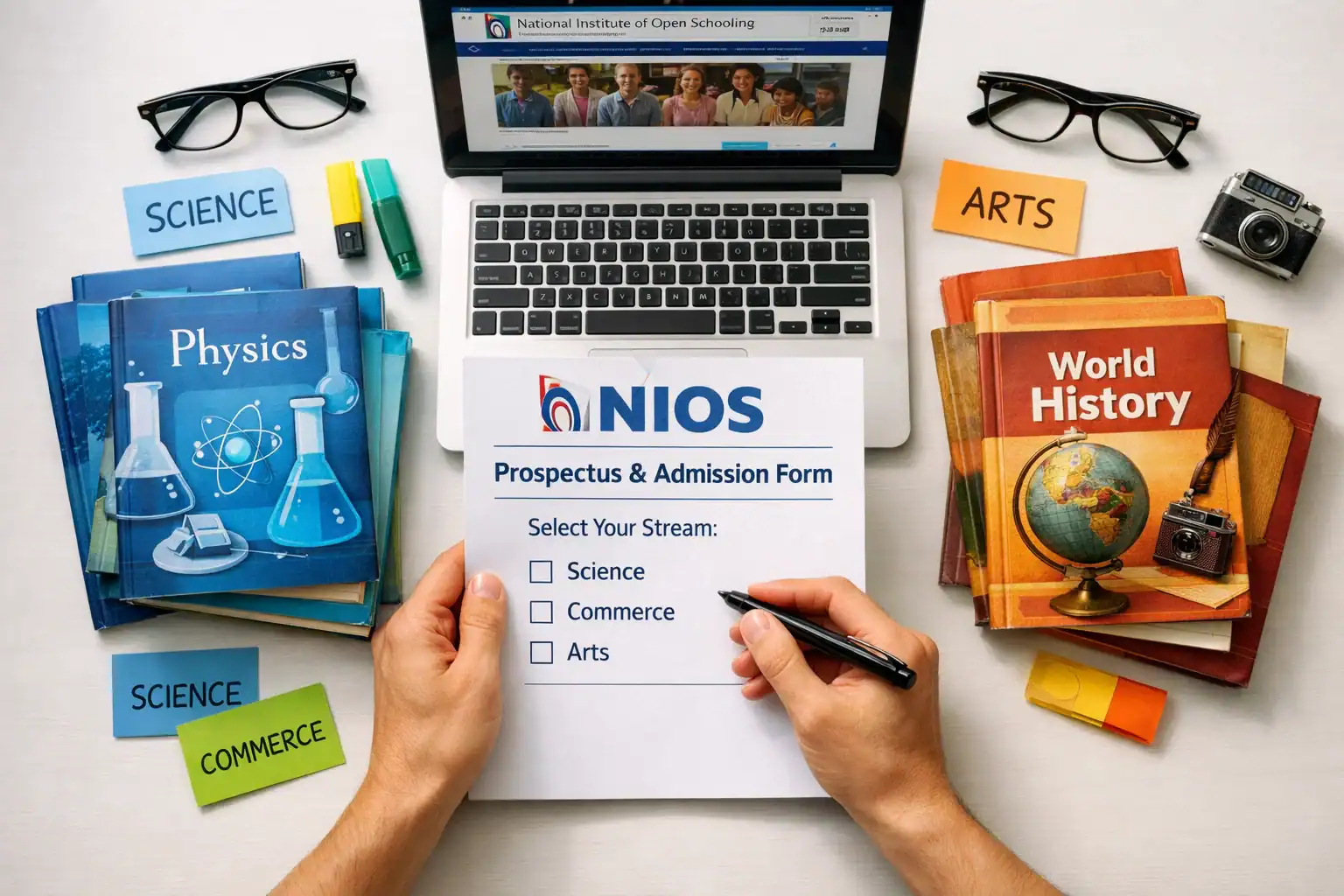
Staring at the NIOS stream selection form while panic sets in because you don’t understand the options? Every year, thousands of students make hasty stream decisions without understanding implications, leading to mismatched career paths, poor academic performance, and years of regret. This mistake costs not just time and money, but potentially derails your entire professional future.
The solution starts here. Understanding exactly what streams NIOS offers, how they differ, and which aligns with your career aspirations ensures you make informed decisions setting up lifelong success. This comprehensive guide reveals everything about NIOS streams, helping you choose confidently and strategically.
A stream represents your primary educational pathway, determining the group of subjects you’ll study during your secondary or senior secondary education. Think of streams as specialized tracks preparing students for specific career directions and higher education opportunities.
NIOS organizes its curriculum into distinct streams, each designed to build knowledge foundations for particular professional fields. Unlike traditional boards offering limited stream combinations, NIOS provides exceptional flexibility allowing students to customize their educational journeys.
Understanding Stream Structure:
At the senior secondary level (Class 12), stream selection becomes crucial as it directly impacts college admissions and career options. Your chosen stream determines which undergraduate programs you can pursue and which competitive examinations you’re eligible for.
NIOS recognizes that modern careers often require interdisciplinary knowledge. The board’s flexible approach enables students to create unique academic profiles combining subjects from different streams, something traditional education boards rarely permit.
Stream vs Subject Selection:
Many students confuse streams with individual subjects. Your stream represents the broad category (Science, Commerce, Arts, or Vocational), while subjects are specific courses within that category. For example, Science stream includes subjects like Physics, Chemistry, Biology, and Mathematics.
The beauty of NIOS subject selection lies in its flexibility. Unlike rigid traditional boards, NIOS allows mixing and matching subjects from different streams, creating personalized academic combinations matching your unique career goals and interests.
Importance of Correct Stream Choice:
Your stream decision shapes your academic trajectory for years ahead. It determines which college courses you qualify for, which entrance exams you can attempt, and ultimately which career paths remain accessible.
Making informed stream choices requires understanding your interests, aptitudes, career aspirations, and long-term goals. Rushing this decision without proper research often leads to dissatisfaction and costly course corrections later.
NIOS provides three primary academic streams at the senior secondary level, each catering to different educational and career objectives. These streams align with national education standards while offering the flexibility that makes NIOS unique.
The Three Main Academic Streams:
Science Stream targets students aspiring for careers in engineering, medicine, research, technology, and applied sciences. This stream builds strong foundations in scientific principles, mathematical reasoning, and analytical thinking essential for technical professions.
Commerce Stream prepares students for business, finance, accounting, economics, and entrepreneurial careers. It develops commercial awareness, financial literacy, and business management fundamentals required in corporate and commercial sectors.
Arts/Humanities Stream serves students interested in social sciences, languages, literature, psychology, history, political science, and creative fields. This stream nurtures critical thinking, cultural awareness, and communication skills valuable across diverse careers.
Stream Selection Framework:
Unlike traditional boards requiring students to choose one exclusive stream, NIOS permits flexible subject combinations. Students can select subjects primarily from one stream while adding complementary subjects from other streams, creating hybrid academic profiles.
This flexibility particularly benefits students with diverse interests or those pursuing unconventional career paths requiring multidisciplinary knowledge. For instance, a student interested in health management could combine Biology (Science) with Business Studies (Commerce).
Beyond Traditional Streams:
NIOS extends beyond conventional academic streams through extensive vocational education programs. These vocational streams provide practical skill development alongside academic learning, preparing students for immediate employment opportunities while keeping higher education pathways open.
The availability of multiple streams ensures every student finds educational pathways matching their aptitudes, interests, and career aspirations, regardless of how conventional or unique those goals might be.
The Science stream represents one of NIOS’s most popular choices, attracting students aspiring for careers in engineering, medicine, research, technology, and scientific fields. Understanding available subjects helps students make strategic selections.
Core Science Subjects:
Physics forms the foundation of engineering and technology careers. NIOS Physics curriculum covers mechanics, electricity, magnetism, optics, modern physics, and thermodynamics, preparing students for competitive exams like JEE Main and Advanced.
Chemistry divides into three segments – Physical, Organic, and Inorganic Chemistry. The subject proves essential for medical aspirants, pharmaceutical sciences, chemical engineering, and research careers. NIOS Chemistry aligns with NEET examination requirements, helping students prepare for medical entrance tests.
Biology becomes crucial for students targeting medical, dental, veterinary, biotechnology, and life sciences careers. The curriculum covers botany, zoology, human physiology, ecology, and genetics, providing comprehensive biological sciences foundation.
Mathematics opens doors to engineering, computer science, economics, statistics, and numerous technical fields. NIOS Mathematics includes algebra, calculus, coordinate geometry, vectors, probability, and statistics, building strong quantitative reasoning abilities.
Supporting Science Subjects:
Beyond core sciences, NIOS offers supporting subjects enhancing scientific education. Environmental Science teaches ecological awareness and sustainability principles. Computer Science introduces programming, algorithms, and digital technologies increasingly relevant across scientific careers.
Science Stream Combinations:
Common science combinations include Physics, Chemistry, Mathematics (PCM) for engineering aspirants, and Physics, Chemistry, Biology (PCB) for medical students. However, NIOS flexibility allows Physics, Chemistry, Biology, Mathematics (PCBM) combinations providing maximum career options.
Students concerned about understanding the NIOS grading system should note that science subjects typically require both theory and practical examinations, with marks distributed accordingly.
Career Pathways:
Science stream graduates can pursue engineering degrees (B.Tech/BE), medical programs (MBBS, BDS, BAMS), pure sciences (B.Sc), pharmacy, biotechnology, agriculture, aviation, merchant navy, and numerous other technical careers.
For students wondering how to clear NIOS exams in first attempt, science subjects require consistent practice, conceptual clarity, and regular problem-solving rather than rote memorization.
Commerce stream prepares students for business, finance, accounting, management, and entrepreneurial careers. NIOS Commerce offers comprehensive business education with flexibility unmatched by traditional boards.
Core Commerce Subjects:
Accountancy teaches financial recording, bookkeeping, financial statements preparation, and accounting principles. This fundamental subject proves essential for CA, CS, CMA aspirants and anyone pursuing finance-related careers. NIOS Accountancy covers practical accounting scenarios relevant to modern business environments.
Business Studies introduces organizational structures, management principles, marketing concepts, human resource management, and business operations. The subject builds entrepreneurial awareness and corporate understanding valuable across commercial careers.
Economics divides into Microeconomics and Macroeconomics, teaching economic principles, market dynamics, national income concepts, monetary policies, and international trade. Economics knowledge benefits students pursuing CA, MBA, civil services, and policy-making careers.
Mathematics in commerce stream differs from science mathematics, focusing on statistical analysis, financial mathematics, linear programming, and business applications. This subject particularly helps students targeting quantitative business roles.
Supporting Commerce Subjects:
Business Economics provides deeper economic understanding with business applications. Entrepreneurship teaches business startup principles, venture planning, and innovative thinking crucial for aspiring entrepreneurs.
Computer Science increasingly becomes important in commerce education, teaching business software applications, data analysis tools, and digital commerce concepts relevant in modern business environments.
Commerce Stream Combinations:
Traditional commerce combinations include Accountancy, Business Studies, Economics, and Mathematics. However, NIOS permits creative combinations like Accountancy, Business Studies, Economics, and Computer Science for technology-oriented commerce careers.
Students can also combine commerce subjects with languages, humanities subjects, or even selected science subjects, creating unique academic profiles matching specific career requirements.
Career Opportunities:
Commerce graduates pursue Chartered Accountancy (CA), Company Secretary (CS), Cost and Management Accountancy (CMA), Bachelor of Commerce (B.Com), Bachelor of Business Administration (BBA), Bachelor of Management Studies (BMS), and numerous other business-related programs.
Banking, finance, insurance, taxation, auditing, stock market analysis, business consulting, and entrepreneurship represent common commerce career pathways. The stream also prepares students for MBA programs and civil services examinations.
Arts or Humanities stream offers the most diverse subject options, catering to students interested in social sciences, languages, literature, psychology, history, and creative fields. This stream develops critical thinking, cultural awareness, and excellent communication abilities.
Social Science Subjects:
Political Science teaches governance systems, political theories, constitutional frameworks, international relations, and democratic processes. This subject particularly benefits civil services aspirants and students interested in law, journalism, or public administration.
History covers ancient, medieval, and modern historical developments, helping students understand societal evolution, cultural heritage, and historical contexts shaping contemporary world dynamics.
Geography combines physical and human geography, teaching environmental processes, resource distribution, population dynamics, and spatial relationships. The subject proves valuable for urban planning, environmental management, and geological sciences careers.
Psychology introduces human behavior, mental processes, personality development, and psychological principles. This increasingly popular subject prepares students for counseling, human resources, organizational behavior, and clinical psychology careers.
Sociology examines social structures, cultural patterns, social change, and human relationships within communities. The subject benefits students interested in social work, anthropology, and community development.
Language and Literature:
NIOS offers numerous language options including English, Hindi, Urdu, Sanskrit, and regional languages. Language subjects develop communication proficiency, literary appreciation, and cultural understanding crucial across all careers.
Philosophy teaches logical reasoning, ethical principles, and philosophical traditions, developing abstract thinking abilities valuable in law, research, and analytical professions.
Arts Stream Flexibility:
Arts students enjoy maximum subject selection flexibility. They can combine social sciences with languages, add mathematics for analytical skills, or include commerce subjects for business understanding. This versatility enables truly customized educational experiences.
Students can explore different subject selection strategies to create optimal combinations matching their career aspirations and personal interests.
Career Pathways:
Arts graduates pursue diverse careers including civil services (IAS, IPS, IFS), law (LLB), journalism, mass communication, psychology, social work, teaching, research, content writing, public relations, human resources, and creative professions.
The stream also prepares students for BA, BSW, BJMc, and other undergraduate programs across humanities and social sciences disciplines.
Beyond traditional academic streams, NIOS offers extensive vocational education programs combining practical skill development with academic learning. These vocational streams prepare students for immediate employment while maintaining higher education eligibility.
Understanding Vocational Education:
Vocational streams focus on job-specific skills and practical competencies required in various trades and professions. Students gain hands-on experience, industry-relevant knowledge, and employability skills alongside theoretical understanding.
NIOS vocational courses carry equal recognition to academic courses, qualifying students for higher education programs while providing immediate livelihood opportunities.
Vocational Course Categories:
Business and Commerce Vocational Courses include Retail Management, Office Management, Banking Operations, Insurance, and Marketing. These courses prepare students for immediate employment in commercial sectors while teaching business fundamentals.
Information Technology Vocational Courses cover Web Designing, Software Applications, IT Applications, Computer Hardware, and Digital Marketing. The rapidly growing IT sector values these practical skills highly.
Healthcare Vocational Courses include Health Care, Patient Care Assistant, Dental Hygiene, and Pharmacy Technician programs. These courses enable entry into healthcare professions without extensive medical degrees.
Engineering and Technology Vocational Courses teach Electrical Technology, Electronics, Automobile Servicing, Construction Technology, and Agricultural Technology, preparing students for technical trades.
Service Sector Vocational Courses cover Hospitality Management, Tourism Operations, Beauty Therapy, and Event Management, preparing students for service industry careers.
Agriculture Vocational Courses include Crop Production, Horticulture, Animal Husbandry, and Dairy Farming, valuable for students interested in agricultural entrepreneurship.
Vocational Stream Benefits:
Students completing vocational courses gain immediate employment opportunities without waiting for graduation. Many start earning while pursuing higher education part-time, achieving financial independence earlier.
Vocational qualifications particularly benefit students from economically disadvantaged backgrounds, providing quick pathways to stable incomes and career progression.
Combining Academic and Vocational Subjects:
NIOS permits students to combine vocational subjects with academic subjects, creating hybrid qualifications. For example, students can study Physics, Chemistry, Mathematics alongside a vocational IT course, gaining both theoretical and practical expertise.
This combination approach maximizes employability while keeping all higher education doors open, providing excellent career flexibility.
One of NIOS’s most revolutionary features is permitting interdisciplinary subject combinations. Unlike rigid traditional boards restricting students to predefined stream combinations, NIOS encourages personalized academic profiles.
Interdisciplinary Flexibility:
NIOS allows students to select subjects from different streams based on interest and career requirements. A student passionate about biotechnology can combine Biology and Chemistry (Science) with Business Studies (Commerce), preparing for biotech entrepreneurship.
Similarly, students interested in data journalism can combine Computer Science (Science) with Mass Communication (Arts) and Statistics (Commerce), creating unique skill sets matching modern career requirements.
Common Interdisciplinary Combinations:
Science + Commerce: Students combine scientific subjects with business studies for careers in pharma management, healthcare administration, or technology entrepreneurship. Common combinations include Physics, Chemistry, Mathematics, and Business Studies.
Science + Arts: Combining scientific thinking with humanities subjects benefits students targeting interdisciplinary fields like environmental policy, science journalism, or psychological research. Examples include Biology, Psychology, Environmental Science, and English.
Commerce + Arts: This combination suits students interested in media management, cultural entrepreneurship, or social enterprise. Typical selections include Accountancy, Business Studies, Psychology, and Mass Communication.
Benefits of Mixed Streams:
Interdisciplinary education reflects modern workplace realities where most careers require diverse knowledge sets. Technology companies need professionals understanding both technical concepts and business principles. Healthcare organizations seek managers with medical awareness and administrative skills.
Creating unique subject combinations differentiates students in competitive admission processes and job markets. Universities increasingly value interdisciplinary applicants demonstrating diverse interests and comprehensive perspectives.
Admission Considerations:
While NIOS permits flexible combinations, students must verify that their chosen subject mix meets specific college or entrance examination requirements. Some professional courses require particular subject combinations for eligibility.
For instance, engineering programs typically require Physics, Chemistry, and Mathematics, while medical programs need Physics, Chemistry, and Biology. Students should research target programs before finalizing subject selections.
Strategic Subject Selection:
Successful interdisciplinary planning requires understanding how different subjects complement each other and align with career goals. Students should consult education counselors, research career requirements, and consider long-term implications before creating customized combinations.
The flexibility to change streams in NIOS provides some safety, though initial careful selection remains preferable to later modifications.
Selecting appropriate streams represents one of education’s most critical decisions, impacting college admissions, career opportunities, and long-term satisfaction. Making informed choices requires systematic evaluation of multiple factors.
Self-Assessment:
Begin with honest self-evaluation identifying genuine interests, natural aptitudes, and subjects you enjoy studying. Your passion for subjects significantly impacts learning motivation, performance, and long-term success.
Consider subjects where you consistently perform well versus those requiring excessive struggle. While challenge drives growth, building on existing strengths typically yields better outcomes than forcing weak areas.
Career Research:
Research careers genuinely interesting to you. Understand educational requirements, typical career paths, growth prospects, and lifestyle implications. Many students choose streams based on prestige or peer pressure rather than genuine career interest.
Investigate specific stream requirements for target professions. Medical careers require Science with Biology, engineering needs Science with Mathematics, CA requires Commerce, while civil services accepts all streams with specific subject advantages.
Interest vs Aptitude Balance:
Sometimes interests and aptitudes diverge. You might enjoy creative writing (Arts) but excel at mathematics (Science). Finding optimal balance between passion and capability requires honest assessment and possibly career counseling.
Consider how different streams align with your learning style. Science requires analytical thinking and problem-solving. Commerce needs numerical ability and business sense. Arts demands reading comprehension, critical thinking, and communication skills.
Practical Considerations:
Evaluate practical factors affecting stream choice including available coaching support, family guidance, financial resources for different career paths, and geographic constraints limiting certain opportunities.
Some careers require extensive additional coaching beyond school education. Science and Commerce streams often need supplementary preparation for competitive exams, while Arts might require specialized training for specific careers.
Future Flexibility:
Consider streams providing maximum future flexibility. Science stream traditionally offers broadest options, allowing lateral movement into Commerce or Arts fields. Commerce provides moderate flexibility, while Arts offers specific advantages in humanities careers.
Understanding NIOS exam patterns helps evaluate difficulty levels across streams, though remember that difficulty remains subjective based on individual strengths.
Expert Guidance:
Consult teachers, career counselors, and professionals in target fields. Their experiences provide valuable insights beyond textbook information. Speaking with current college students in desired programs reveals realistic expectations.
Many students benefit from aptitude and personality assessments providing scientific evaluations of strengths, interests, and suitable career directions.
Avoid Common Mistakes:
Don’t choose streams based solely on peer decisions, parental pressure, or societal perceptions of prestige. Your unique situation, interests, and goals should drive decisions.
Avoid hasty choices without adequate research. Spend time understanding implications, exploring alternatives, and making informed decisions you’ll confidently own.
Students frequently ask which stream offers superior career prospects. The reality? All streams provide excellent opportunities when aligned with individual strengths and interests. Success depends more on skill development and dedication than stream selection.
Science Stream Opportunities:
Science graduates access numerous high-demand careers including engineering, medicine, research, technology, data science, biotechnology, and pharmaceutical industries. The technical skills developed through science education remain consistently marketable.
Starting salaries in engineering and medical fields typically rank among highest for fresh graduates. Technology sector growth creates continuous demand for science-educated professionals.
However, science careers often require extensive education periods. Medical professions need 5-10 years training, engineering requires 4+ years, and research careers demand doctoral qualifications.
Commerce Stream Opportunities:
Commerce opens doors to banking, finance, accounting, business management, entrepreneurship, marketing, and consulting careers. The business world constantly needs commerce-educated professionals.
Professional qualifications like CA, CS, and CMA command excellent salaries and prestige. The entrepreneurial skills developed through commerce education enable business creation and financial independence.
Commerce careers often provide faster entry into workforce compared to science professions. BCom graduates can start working within three years, while CA qualification takes 4-5 years.
Arts/Humanities Opportunities:
Arts graduates excel in civil services, law, journalism, content creation, education, psychology, social work, and creative industries. The communication and analytical skills developed through arts education prove valuable across sectors.
While starting salaries might average lower than science/commerce in some fields, arts careers offer immense growth potential. IAS officers, lawyers, journalists, and psychologists achieve excellent career success and societal impact.
Arts education develops transferable skills like critical thinking, communication, and cultural awareness valuable in any profession. Many successful entrepreneurs and business leaders possess arts backgrounds.
Emerging Career Trends:
Modern careers increasingly require interdisciplinary knowledge transcending traditional stream boundaries. Health technology needs biology and computer science. Fintech combines commerce and technology. Environmental law merges science and humanities.
Digital transformation creates new careers in content creation, digital marketing, UX design, data analysis, and online education where diverse educational backgrounds succeed.
Success Factors Beyond Streams:
Career success depends more on skills, adaptability, networking, continuous learning, and personal initiative than initial stream selection. Passionate arts students often outperform disinterested science students.
Soft skills like communication, leadership, emotional intelligence, and problem-solving prove crucial across all careers, regardless of academic stream origins.
Making Stream-Career Connections:
Rather than asking which stream is “best,” identify careers genuinely exciting to you, then work backward determining appropriate stream requirements. This approach ensures alignment between education and aspirations.
Research shows career satisfaction correlates strongly with interest alignment rather than income levels. Choosing streams matching passions typically yields both fulfillment and financial success.
Life circumstances change, interests evolve, and sometimes initial stream selections prove misaligned with actual preferences. NIOS recognizes this reality through flexible stream modification policies.
NIOS Stream Change Policy:
Unlike traditional boards with rigid stream restrictions, NIOS permits stream changes under specific conditions. Students can modify their stream selections, though procedures and limitations exist.
Understanding how to change stream in NIOS requires knowing eligibility criteria, application processes, fee implications, and timeline restrictions.
When Can You Change Streams?:
Stream changes typically occur during specific windows within the academic session. Students cannot change streams immediately before examinations or after certain deadlines pass.
The optimal time for stream changes is early in the course, preferably during admission year before significant subject completion. Later changes might require restarting certain subjects or losing completed credits.
Process for Changing Streams:
Students must submit formal applications through NIOS regional centers or online portals. The application includes reasons for stream change, new subject selections, and required documentation.
NIOS evaluates change requests based on eligibility, subject availability, and academic progress. Approval isn’t automatic; students must demonstrate valid reasons and meet conditions.
Subject Credit Transfers:
When changing streams, students might retain credits for common subjects appearing in both streams. For example, English and Mathematics credits transfer when moving from Science to Commerce.
Understanding Transfer of Credit (TOC) in NIOS helps students maximize retained credits and minimize repeated coursework.
Financial Implications:
Stream changes often involve fees including application charges, new subject registration fees, and study material costs. Students should budget for these expenses when considering modifications.
Academic Impact:
Changing streams disrupts academic continuity and might extend course completion timelines. Students must honestly assess whether stream change benefits outweigh delays and additional efforts.
Sometimes subject additions or deletions within the same stream address concerns better than complete stream changes. Students should explore all alternatives before major modifications.
Prevention Through Careful Planning:
The best approach remains making well-informed initial choices through thorough research, self-assessment, and career counseling. While NIOS provides change flexibility, avoiding unnecessary modifications saves time, money, and effort.
Students uncertain about stream choices can seek guidance from NIOS counselors, education experts, and career advisors before finalizing initial selections.
Stream 1 Block 1 refers to the first academic grouping in NIOS’s course structure. Understanding what Stream 1 Block 1 means in NIOS helps students navigate their subject organization and examination scheduling effectively.
Yes, NIOS permits students to take both Biology and Mathematics simultaneously, allowing you to keep both medical and engineering career options open. This flexibility distinguishes NIOS from traditional boards with restrictive subject combinations.
Absolutely. NIOS Science stream with Physics, Chemistry, and Mathematics qualifies students for all engineering entrance examinations including JEE Main and Advanced. NIOS certificates carry equal validity as CBSE or state boards for competitive exams.
Difficulty remains subjective based on individual strengths and interests. Students naturally find streams aligning with their aptitudes easier. Rather than seeking “easiest” streams, choose options matching your strengths and career goals for optimal performance.
Yes, NIOS allows subject modifications within certain timelines and conditions. However, changes should occur early in the academic session to avoid complications with examinations and course completion.
Yes, NIOS vocational certificates carry equal recognition as academic streams for higher education and employment. Vocational students qualify for college admissions while possessing additional practical skills enhancing employability.
NIOS requires minimum five subjects for secondary level and five subjects for senior secondary level, with at least one language subject mandatory. You can select more subjects if desired, including subjects from different streams.
Yes, NIOS certificates are valid abroad for higher education and employment. However, some international institutions might require credential evaluation for understanding NIOS equivalency to their educational systems.
Understanding NIOS streams empowers you to make strategic educational decisions aligning with your unique interests, aptitudes, and career aspirations. Whether you choose Science for technical careers, Commerce for business paths, Arts for humanities professions, or Vocational streams for practical skills, NIOS provides flexibility unmatched by traditional education boards.
The beauty of NIOS lies not just in its stream diversity but in its revolutionary approach permitting interdisciplinary combinations. This flexibility mirrors modern workplace realities where most careers require multifaceted knowledge and diverse skill sets.
Your stream selection should reflect honest self-assessment rather than external pressures or prestige perceptions. All streams offer excellent opportunities when pursued with dedication, passion, and strategic planning. Success ultimately depends on your commitment, continuous learning, and adaptability rather than which stream you initially choose.
Take time researching career requirements, understanding subject implications, and consulting experts before finalizing stream decisions. While NIOS offers change flexibility, making informed initial choices saves valuable time and resources.
Ready to begin your NIOS journey? Explore our comprehensive guides on how to enroll in NIOS, understand NIOS exam patterns, and discover strategies for clearing exams in first attempt.
Your educational path shapes your future – choose streams aligning with your authentic aspirations, and NIOS’s flexibility will support your success journey.